Climate Change and the Rising Threat of Flash Floods in Gilgit-Baltistan
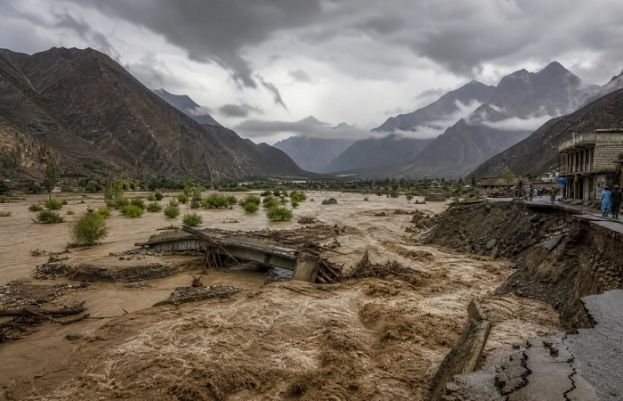
The impacts of climate change are no longer distant projections—they are visible across the region. Summers are becoming warmer, glaciers are melting faster, snowfall patterns are changing, and pre-monsoon and monsoon rainfall has become more intense and unpredictable. These changes have significantly increased the risk of flash floods, glacial lake outburst floods (GLOFs), landslides and debris flows.
Flash floods have become one of the most destructive climate-related disasters in Gilgit-Baltistan. Unlike river floods, flash floods develop within a short period after heavy rainfall, cloudbursts or sudden releases of water from glacial lakes. The steep mountains, narrow valleys and fragile geology of the region allow water to flow rapidly, carrying rocks, mud and debris that destroy everything in their path. Roads, bridges, irrigation channels, schools, health facilities and agricultural land are often damaged within hours.
Recent years have demonstrated how climate change is increasing these risks. Several valleys in Diamer, Gilgit, Hunza, Ghizer, Ghanche, Shigar and Astore have experienced repeated flash floods triggered by heavy rainfall and accelerated glacier melt. During the summer of 2022, unprecedented floods damaged thousands of homes, washed away roads and disrupted livelihoods across the region. In 2025 and 2026, repeated pre-monsoon rainfall and high temperatures again raised concerns over glacier melt, prompting the National Disaster Management Authority (NDMA) to issue multiple alerts for Gilgit-Baltistan due to the heightened risk of flash floods and GLOFs.
The impacts extend far beyond physical destruction. Farmers lose crops and fertile land, tourism declines as roads become inaccessible, electricity generation is disrupted, drinking water systems are damaged and families are displaced. Every flood also places an additional financial burden on a region where communities rely heavily on agriculture, tourism and small businesses.
Scientists warn that the Hindu Kush–Karakoram–Himalaya region is warming faster than the global average. As glaciers continue to retreat and extreme rainfall events become more frequent, flash floods are expected to occur more often and with greater intensity. This means that disasters once considered rare may become a regular feature of life in many mountain communities.
Addressing these challenges requires more than emergency response. Stronger early warning systems, climate-resilient infrastructure, improved land-use planning, glacier monitoring, watershed management and community-based disaster preparedness are essential. Local communities also need greater awareness and resources to adapt to changing climate conditions.
Gilgit-Baltistan contributes only a tiny fraction of global greenhouse gas emissions, yet it faces some of the world's most severe consequences of climate change. The growing frequency of flash floods is a reminder that climate change is not merely an environmental issue—it is a threat to livelihoods, infrastructure, food security and sustainable development. Protecting the region will require coordinated action from governments, scientists, development partners and local communities before these disasters become even more devastating.
from Latest Pakistan News - SUCH TV https://ift.tt/xb9Lso0


No comments